
What the **** are you doing?
I’m going to outline here a general method that I think will help language learners as they approach a foreign language.
There are a few ways of communicating the essential sprit of this method. But I’d like to present it as essentially the process of creating a stepping stone language between a learner’s native language (the source language) and the language they are learning (the target language). What makes this approach easier is that this stepping stone language can be acquired more readily, because it uses only vocabulary from their source language while at the same time reflecting the grammar of the target language. Once readers have internalized this stepping stone language, they can then slowly begin to substitute the words they learn into it, until they are fully speaking the target language.
I first developed this system, which can essentially be understood as formalizing “interlinear gloss” into its distinct language-system, as an artistic method.
Language learning today generally begins with learners memorizing a substantial amount of vocabulary before even being introduced to the grammar. It’s exhausting and doesn’t lead to anything tangible, and learners are then doubly discouraged when they find out that learning to order the words correctly is its own and greater challenge. It can make a lot of language learners feel like they are performing a lot of labor for very little gain. I want this method to appear to learners like simply reading a strange book, not like generally learning anything at all. And by doing so, they’ll be doing the harder part first.
Another way I’ve communicated its essential sprit before is as a “hyper-literal” translation. A more academic version of that would be to call it a “morphological translation.” Morphemes refer to the smallest undivided units of meaning in a language.
The resource I’ve made below is something I made to help Spanish speakers learn English. And to do so, I’ve rendered a translation of the opening passages of Hemingway’s The Old Man and the Sea in this method, preserving all of the general formal rules of English but using only Spanish words.
If you are bilingual English-Spanish speaker, please look through the grammar rules I include at the end of this article and leave me any suggestions. I’d like to learn what sounds natural and unnatural to native Spanish speakers. I’d also be really interested in any suggestions from ESL teachers with mostly hispanic students.
El Viejo Hombre y El Mar
Él era un viejo hombre quien pascado en un esquife en el Golfo Corriente y el había ido ochenta-cuatro días ahora sin tomando un pez. En el primero cuarenta días un niño había sido con él. Pero después cuarenta días sin un pez el niño-de padres había dicho él que el viejo hombre fue ahora definitiva y finalmente salao, cual es el peor forma de desafortunado, y el niño había ido a suyo órdenes en un-otro bote cual tomado tres bon peces el primero semana. Eso hecho el niño triste a ver el viejo hombre venir-en cada día con suyo esquife vacío y él siempre iba baja a ayudar lo cargar o el enrollado líneas o el bichero y arpón y el vela que fue enrollado alrededor el mástil. El vela fue remendado con harina sacos y, arrollado, eso parecido como el bandera de permanente derrota.
El viejo hombre fue flaco y desgarbado con profundos arrugas en el posterior de suyo cuello. El marrón manchas de el benigno piel cáncer el sol llevars desde eso-de reflexión sobre el trópico mar fueron sobre suyos mejillas. El manchas corrido bien baja el lados de suyo cara y suyo manos habido el profundo-doblado cicatrices desde agarrando pesado pez sobre el cabos. Pero ninguno de estos cicatrices fueron fresco. Ellos fueron igual viejo igual erosiones en un pez-menos desierto.
Cada-cosa acerca-de lo fue viejo excepto suyo ojos y ellos fueron el mismo color igual el mar y fueron alegres y invictos.
“Santiago,” el niño dicho a lo igual ellos ascendido el banco desde donde el esquife fue varado arriba. “Yo podría ir con tú otra-vez. Nosotros-han hecho cualquier dinero.”
El viejo hombre había enseñado el niño a pescar y el niño querido lo.
“No,” el viejo hombre dicho. “Tú-son un con-suerte bote. Quedar con ellos!”
“Pero recordar como tu iba ochenta-siete días sin pez y luego nosotros cogido grandes unes cada día por tres semanas.”
“Yo recordar,” el viejo hombre dicho. “Yo saber tu hecho-no dejado me porque tu dudado.”
“Eso fue papa hecho me dejar. Yo soy un niño y yo tener-que obedecer lo.”
“Yo saber,” el viejo hombre dicho. “Eso es bien normal.”
“El ha-no tanto fe”
“No,” el viejo hombre dicho. “Pero nosotros han. Han-no nosotros?”
“Si,” el niño dicho. “Puede yo ofrecer tú un cerveza en el terraza y luego tomar el cosas casa.”
“Porque no?” el hombre viejo dicho. “Entre pescadores”
Why Hemingway? An Appeal to the Hemingway Estate
I’m going to make an ask here of the Hemingway Family and Foundation, as well as Simon and Schuster, who hold the translations rights to this book. If there’s a lot of positive feedback, and if a lot of native Spanish language speakers show interest in this being a potentially useful tool for them, please allow me the honor of creating a full translation of The Old Man and the Sea in this capacity. And please, let us make it accessible to everyone who would like to learn English through it.
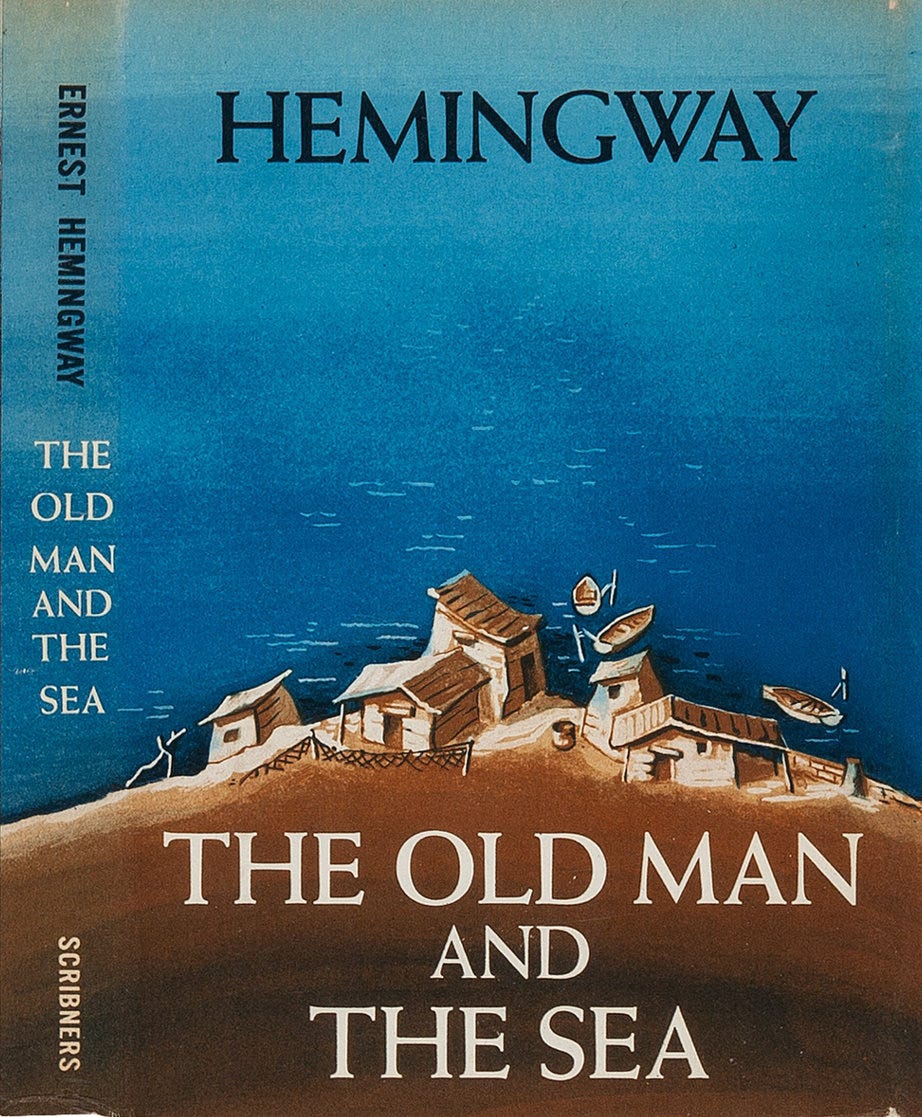
I wanted to do this with Ernest Hemingway’s the Old Man and the Sea for a few reasons. Most intimately, I picked up this copy, written in Cuban Spanish, at the San Carlos Institute when I took a trip to Key West in the winter of 2024 into 2025, on my way back from visiting the Hemingway House. It was the first full-length fiction book I read in Spanish. And for that reason, it will always hold a special place in my heart. It feels strange now to read the book in English. It feels so at-home in Spanish.

And secondly, it is about a poor fisherman in Cuba, all of his losses and all of his triumphs. It doesn’t demean or patronize him. Hemingway imagined this man’s world as interesting, as dramatic, as complicated, and as bittersweet as his own. Hemingway saw himself in the every day working people of Cuba and saw them as ideals to aspire to. Ideals of diligence, and labor, and ambition.
I want this translation to not only be for Spanish-speakers but about them as well. If we wish for them to see the best in us, through all our misgivings, we must first show just how deeply we see the best in them.
But more fundamentally, Hemingway’s writing style, of sparse simple sentences, was almost made for learners. He has the capacity to talk about the most profound things embedded within human existence without needing to use more than a few sentences in an entire novel with more than three clauses. To me, this is as difficult of a book one needs to be able to read to be generally conversational in English. The simplicity of the language and the timelessness of its lessons has no rival.
Furthermore, if this will be an entryway to people learning English and learning American English, I want Hemingway to be the one to greet them at the gate.
Hemingway, in addition to being an American’s idea of an American, is also the rest of the world’s idea of an American. There is something to be said about Hemingway that can’t as easily be said about other authors: that understanding him, in some capacity, is to understand America. Our driving spirit, our reckless ambition, our silence in the face of our greatest private struggles.
So much ink has been spilled about Hemingway, in praise and in denunciation. So much ink has also been spilled about America, in praise and in denunciation. But none seem to be able to actually capture either’s essence. Perhaps their essences are far too complicated to be summed up as easily, by any singular emotion. We are a messy, complicated, often deeply misunderstood, but also mistaken, country. And just as America is all those things as a nation, Hemingway was as a man.
So please, let Ernest let Hemingway, who has guided us in so much already, be the one to hold the door open to a new generation of Americans. There’s no one greater and no one more deserving to hold the keys to the gate, to show everyone who wants to live a life here, that they are entering a land where dreams soar and where no one is ready to fall into their grave, until they are convinced, and they will never be convinced, that they have spent their entirety in the service of something much greater than themselves.
Translation Rules (So Far)
Verbs
Regular Verbs
Present tense:
To reflect English’s, sometimes truly puzzling, lack of inflection, the standard form of a verb (whatever follows ‘to’ in our fake infinitives like ‘to fish’), is represented by the full infinitive in Spanish.
I fish = Yo pascar
You fish = Tú pascar
We fish = Nosotros pascar
They fish = Ellos pascar
The only exception is, of course, the third person singular. Here simply add an ‘s’ at the end of an infinitive.
He fishes / she fishes: el pascars / ella pascars
Simple past:
Since English’s past participles are most commonly their simple past, I wanted to reflect that in the construction of the simple past. This way, Spanish speakers will know simply to reach for the past participle to get at the simple past.
I fished = Yo pascado
You fished = Tú pascado
He fished / she fishes: el pascado / ella pascado
We fished = Nosotros pascado
They fished = Ellos pascado
I suspect some people will be disappointed by this flattening. The outstanding majority of all irregularities in English words happen in the past-tense. But the truth is, this isn’t something that I think I can take into account all the different ways in which they are irregular in a way that isn’t going to make this system as complicated as English itself.
Since irregular past tenses are already something English students spend a lot of time drilling, I’ll leave perfecting their tenses to the part of their language-learning journey after internalizing the regularities through this system.
Simple future
The simple future in English is made by simply preceding the regular verb form with ‘will’ or ‘shall’. So all this requires is for us to come up with a set phrase that indicates something naturally in the future in Spanish.
I went with: “va-a”
I will fish = Yo va-a pascar.
Present Participle Tenses:
All -ing constructions, whether the gerund or the present participle, use Spanish’s -ando/iendo endings.
He’s fishing = el es pascando
We’ll get how to how ‘ser’ is conjugated below in the irregular verbs section.
Perfective Tenses:
He has fished = el ha pascado
He had fished = el había pascado
I have fished = Yo han pascado
We have fished = Nosotros han pascado
They have fished = Ellos han pascado
We had fished = Nosotros había pascado
They had fished = Ellos había pascado
Here is the translation for all the forms of ‘to have’ to construct any perfective tense
has = ha
have = han
had = habido
Irregular Verbs in the Present
Here are the conjugations for all verbs that are
Estar is dropped completely. All ‘to be’ conjugations are done through ‘ser’
To be
I am = Yo soy
You are = Tú son
She is / He is = Ella/el es
We are = nosotros son
They are = ellos son
I was = Yo era
You were = tu fueron
He was / she was = el era / ella era
We were = nosotros fueron
They were = ellos fueron
Since our other irregular verbs aren’t even that irregular, I’ll give very straightforward plug-in translations. These are meant to be valid whenever you see any of these verbs in these forms.
‘To go’
go = ir
goes = va
went = iba
gone = ido
‘To have’
has = ha
have = han
had = había
Modal Auxiliaries:
can = puede
could = podria
will = va-a
would = iría-a
Negation Using ‘Do(es) not’
In order to negate any verb, we use a mirror of English’s auxiliary ‘do not’ construction.
do = hacen
does = hace
did = hacía
done = hecho
I do not fish = Yo hacen-no pascar.
I did not fish = Yo hacía-no pascar.
He does not fish = Él hace-no pascar.
He did not fish = Él hacía-no pascar.
We do not fish = Nosotros hacen-no pascar.
We did not fish = Nosotros hacía-no pascar.
Pronouns
Subject and Object Forms of Personal pronouns
English has many of the same generaly pronoun categories as Spanish.
Here are the subject forms
I = Yo
You = Tú
He = él
She = ella
We = Nosotros
They = Ellos
The object forms are
Me = mí
You = tú
Him = lo
She = la
Us = nos
Them = los
The object forms are a mix of the prepositional forms and the direct object forms (only for when a case arises in which Spanish re-uses the subject pronoun in its prepositional form as well; there’s also the case with English’s you, which is case-independent, so I just used ‘tú’.
Demonstrative Pronouns
Since Spanish has three distances (esto, eso, aquello) and English two (this, that), Spanish’s middle distance is dropped, which frees up ‘eso’ to be our general translation for ‘it,’ which Spanish needs because its pronouns don’t encode animacy.
This = Esto.
That = Aquello.
It = Eso.
And since English does not make a different between ‘this’ and ‘that’ as pronouns or demonstrative adjectives, neither will this system.
This boat = Esto bote.
I like this = Yo querer esto.
Because, Spanish distinguishes its possessive adjectives and possessive pronouns with more precision than English, all the instances in which they are the same, Spanish takes the possessive pronoun to mean both
His boat = Suyo bote.
This boat is his = Esto bote es suyo.
However, the distinction remains intact where English also makes a distinction between the two.
My boat = Mi bote.
This boat is mine = Esto bote es mio.
English’s Genitive Case
the ‘ ‘s ’ in English’s genitive case is always rendered simply ‘-de’
Santaigo’s boat = Santiago-de bote
Grammatical Gender
All grammatical gender is dropped. All gender-variable adjectives in Spanish take the masculine ending.
An old man = un viejo hombre
And old woman = un viejo mujer
Prepositions
All instances in which any of these pronouns are used, they have a very direct translation within the system.
to = a
of = de
from = desde
with = con
by = para
for = por
in = en
without = sin
as = igual *
about = acerca-de
* I’d like some help on this one. I think it can work with ‘igual,’ but it feels to me like there must be a better fit for it.
‘As’ in English is used in a few contexts, but the two most prominent to my mind is for comparison and temporal constructions.
It sounds works for the former.
He is as tall as her = El es igual grande que la
But it gets awkward with the temporal use
‘Santiago’ the boy said to him as they climbed = ‘Santiago,’ el niño dicho a lo igual ellos ascendido
Please give me any suggestions.
Other points
All instances of ‘to have’ get conjugated using ‘haber,’ which is a completely auxiliary verb in Spanish. The more general meaning of ‘to have’ is done by ‘tener,’ including ‘have to’ as an obligation. All of this gets flattened into ‘haber’ in this system to impress onto the reader that there is no distinction in English. I think it’s a better choice, since ‘to have’ and ‘haber’ are much more similar phonetically.
‘Estar’ is dropped completely. All ‘to be’ constructions are done through ‘ser’.