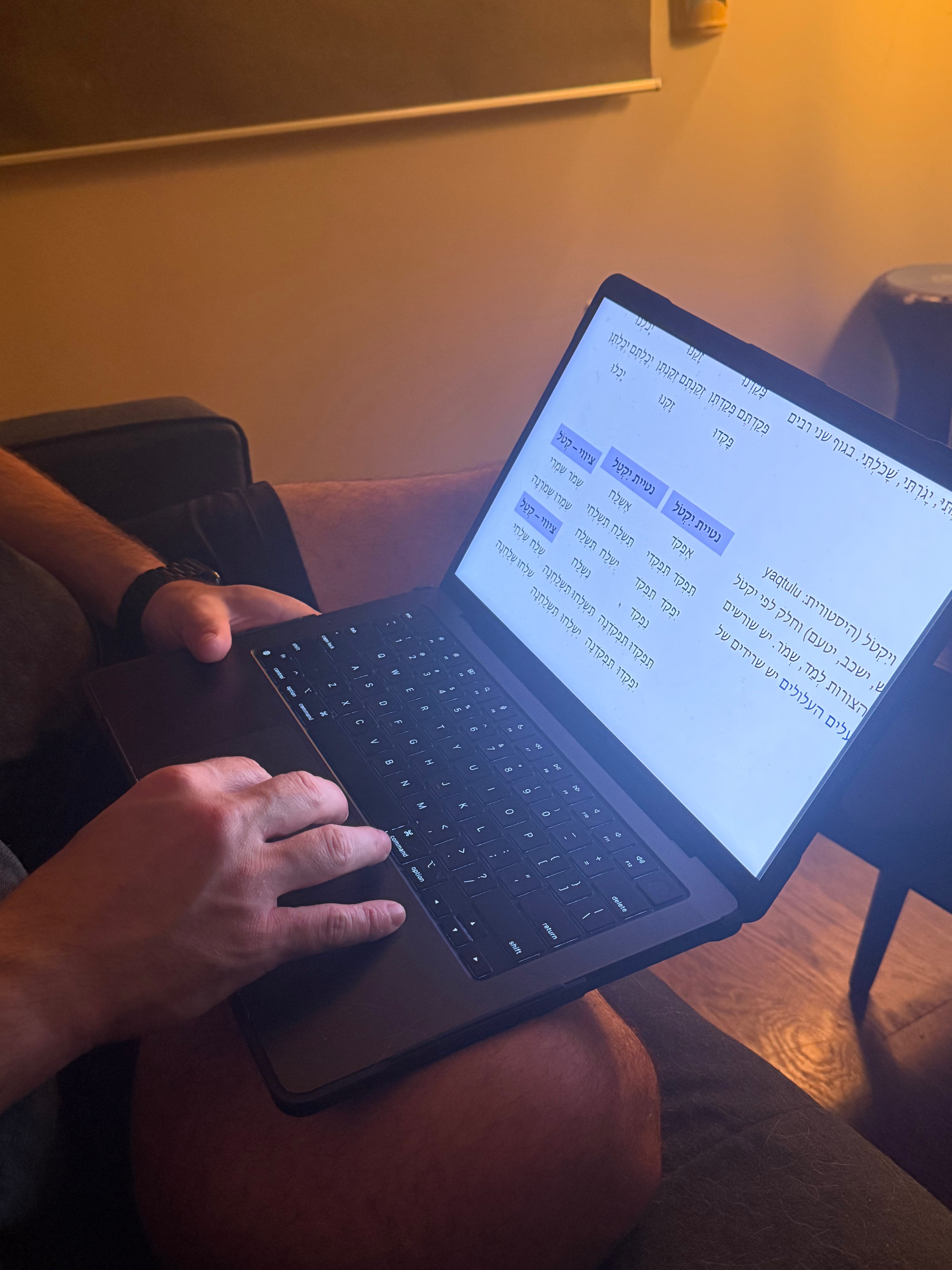
Here is the first piece I’m going to publish online of what I’m going to call my “hyper-literals.”
This is a translation form / verse type that I first made to translate into English phrases or expressions phrases from Tamil (one of the languages I grew up speaking) that I found beautiful, but whose beauty I couldn’t always find a way to fully represent in standard translation.
The verse form essentially attempts a morpheme-by-morpheme translation from a source language into something English-intelligible, using exclusively English vocabulary.
Ecclesiastes (or Koholet) tells the story of King Solomon as he enters old age and reflects on all the endeavors of his life, slowly coming to terms with the meaningless of all things. There are no easy religious answers it tries to present. It’s a true work of art in how its greatest offerings to us are questions, not answers.
I’ve remarked to my friends on a few occasions that I sometimes think of my life before Ecclesiastes and my life after Ecclesiastes. There are whole categories all of my past behaviour that I remember from time to time and then think to myself, “It’s alright. That was before I read Ecclesiastes.”
I think the only other book I can saw that about with as much confidence is Tirukurral.
Translation, Hyper-Literal
1. Words-of Assembling-he, son-David, King in-Jerusalem

2. Mist-(and)-Mists, said-he Assembling-he, the-all (is) mist

3. What profit (is there)  for-the-human (for-the-Adam) in-all toil-his that-will-he-toil under the-sun?

4. Generation going-he and-generation coming-he, but-the-land for-forever standing-she 1

5. And-will-he-rise the-sun and-returning-he, and-to-post-his returning-gasping-he. And rising-he he there (again)

6. Going-he to-south and-turning-he to-north, turning-he turning-he the-wind 2, and-on-circuits-his returning-he the-wind

7. All-the-monsoon-river-wadis going-they to-the-sea, (but) the-sea being-not full. To-post that-the-monsoon-river-wadis going-they, there they returning-they for-go (again)

8. All-words-things growing-weary, no-will-be-able-he any-man to-be-spoken. Not-to-be-made-full the eye to-see (is). And-not-to-be-made-full the ear from-to-hear.

9. What-that-became-he is that-will-he-be, and-what-that-was-done-he is that-will-he-be-done. And there-exists-not all-new under the-sun.

10. There-exists word-thing that-will-say-he "See-this! New it-is." Already was-he, in-ages that from-before-us (from-to-faces-our).

11. There-exists-not memory for-the-first; and-also for-the-laters that-will-they-be, no-will-he-be for-them memory be-will with to-the-last.
Notes
1 One theme that I saw so clearly in the original Hebrew that obviously cannot be translated into English is the gender of the nouns that the speaker chose to use. I think it comes out, using my pidgin-translation the clearest here. Where the choice of word (generation / דּוֹר / dor) to describe people as they come and go are masculine, but the word for the earth or the land is feminine.
It really does feel to me like there’s a small commentary there about men running around with their heads on fire, driven around by burning existential dread to make their lives meaningful, while the women are so much more capable of finding peace and stability amid the meaningless of existence, which is clear to them as well.
Other instances in this passage that, I feel reflect this, is Line 6. There the word for “circuits” is in the feminine plural form. My pidgin system for Biblical Hebrew encodes noun plurals, like English, independent of gender, so it isn’t reflected even in my translation above. I want to find a way to pull out those hidden gender markers while still preserving the poetry of the text.
I wish there was another example of this phenomenon in the above lines to make this gendered dynamic clear, but I’ll leave it by noting that all of the nouns chosen to mirror the going and coming and futile nature of existence (the sun, the wind, the rivers) are all masculine. And when the place they return to that is stable also happens to be masculine (the sea is a good example), they are written to avoid any explicit gender marker. Contrast this with the “land”, which is given a verb so that her gender is made clearer.
2 One thing that stood out to me when reading it in original Hebrew (and perhaps it could be and this could be an indication of just the fact that it was much harder for me than reading it in English), but the feeling of exhaustion is just so much more clearer in the original text. The King James, for example, instead of repeating the verb as is done in the original Masoretic, it just says “whirling about continually”
King James Translation
Here’s the King James Translation of the same 11 lines to help you follow along if you need!
1:1 The words of the Preacher, the son of David, king in Jerusalem.

1:2 Vanity of vanities, saith the Preacher, vanity of vanities; all is vanity.

1:3 What profit hath a man of all his labour which he taketh under the sun?

1:4 One generation passeth away, and another generation cometh: but the earth abideth for ever.

1:5 The sun also ariseth, and the sun goeth down, and hasteth to his place where he arose.

1:6 The wind goeth toward the south, and turneth about unto the north; it whirleth about continually, and the wind returneth again according to his circuits.

1:7 All the rivers run into the sea; yet the sea is not full; unto the place from whence the rivers come, thither they return again.

1:8 All things are full of labour; man cannot utter it: the eye is not satisfied with seeing, nor the ear filled with hearing.

1:9 The thing that hath been, it is that which shall be; and that which is done is that which shall be done: and there is no new thing under the sun.

1:10 Is there any thing whereof it may be said, See, this is new? it hath been already of old time, which was before us.

1:11 There is no remembrance of former things; neither shall there be any remembrance of things that are to come with those that shall come after.
Note to Literary Agents
I end all of the content I make about my hyper-literal verse form with a call to any literary agents watching/reading.
I have a manuscript nearing completion in which alternating passages are written in a similar experimental verse form, combining English vocabulary with Tamil syntax and morphology. I myself grew up speaking Tamil and English at home.
Its first chapter has already been published in The Black Warrior Review’s 2026 Summer Edition (and they didn’t even know about its linguistic origins until after they accepted the submission; I suppose they just felt it naturally poetic).
In my view, Tamil makes for much better reading in this kind of morpheme-by-morpheme translation, because of its agglutinative nature. Performing it in person in the underground poetry scene in New York always edifies my belief that most English-language speakers are able to follow along effectively, with effort but without great issue.
Below is a brief synopsis of the novel.
America Is The World tells the story of Narasimha, a young man as he first comes of age in rural Tamil Nadu. There, his frustrations grow with the prejudices and suffocating social norms, particularly around love and relationships, of his homeland. There he dreams idly of one day living in America, a land he has only seen on television and in movies, a land he dreams is free of prejudice and hatred—a land where he believes love blooms free.
When his life in Tamil Nadu begins to fall apart, he accepts a coyote smuggler’s offer to bring him to the United States, where he is promised work as a meat packer. He accepts the offer, but he soon discovers that his new home is far from what he imagined. Made to work 12-hour shifts for months on end with only a few hours of sleep each night, the physical toll as well as the emotional disassociation required to slaughter animals on an industrial scale soon begin to pull apart his consciousness, as he begins to self-medicate with hard drugs.
Through his journey, he comes to find the beauty and the horror in the American dream. Although it tells a painful story of immigration and disillusion, the work never lets go hidden its love for this land and its people.
The novel is far from auto-biographical, but it mirrors my own story with America. I have come to love America more than most Americans can understand, as someone who’s had to fight for every squared inch of his place within it.
My running joke with my friends Yitz and Yeshaya is that they’ll throw me a Bar Mitzvah once I earn a literary agent to represent this book. If you live in New York, dear literary agent, I’d be more than happy to invite you.
Notes of Infinite Thanks
Thank you so much to my dear friends Yeshaya and Yitzchak. This would not have been possible without your help. Thank you for your patience with me, even onto the late night. Without you, I would have gone mad trying to understand what AI slop I could trust and what AI slop I couldn’t. I don’t know what austerity I’d performed in a previous life to be given friends who could so effortlessly explain the grammar of Biblical Hebrew in their apartment over beer.
The two of you have helped me through so much in life already, before I had even considered asking you for help with this.